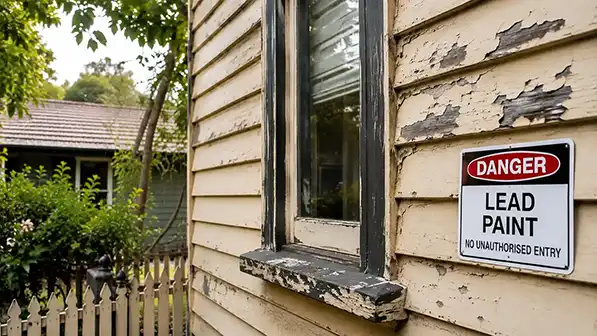
Does my Melbourne home have lead paint?
Lead was a common ingredient in Australian house paints until 1970, when regulations began phasing it out. Homes built between 1970 and 1997 may also contain lead at lower concentrations, particularly in older repaint layers on window frames, trims, fascias and doors. As a rough guide:
- Built before 1970: assume lead paint is present until tested
- Built 1970–1997: possible, particularly on exterior surfaces and trims
- Built after 1997: very unlikely, though not impossible in renovation layers
Lead paint that is in good condition and left undisturbed poses minimal risk. The hazard arises when the paint is disturbed through sanding, scraping or sawing — creating dust or chips. This is why the professional approach matters so much when repainting older homes in Melbourne's eastern and inner suburbs, where pre-1970 stock is common.
See our exterior painting page for how we approach surface preparation on older Melbourne homes, or contact us to discuss your specific property.
How to test for lead paint
DIY lead test kits are available at most hardware stores for around $30–$50. They give a basic yes/no result. For a full room-by-room assessment — particularly before renovation or if you have young children — a professional lead inspection or XRF (X-ray fluorescence) test is more reliable and non-destructive.
Remove or encapsulate? Your two main options
When lead paint is confirmed on surfaces due for repainting, you broadly have two approaches. Neither is universally better — the right choice depends on surface type, paint condition and how the space is used.
Encapsulation
Encapsulation means applying a bonding primer and quality topcoat directly over the lead paint, sealing it in place. This is the right approach when:
- The existing paint layer is well-adhered and not peeling or flaking
- The surface is not subject to friction or impact (not door edges, window sashes or floors)
- You want to minimise disturbance and dust generation
Encapsulation is faster and cheaper than removal. When done correctly with an appropriate primer system, it is a legitimate long-term solution. Future painters will still need to be informed that lead paint exists beneath — which is why we always advise documenting it in writing.
Full removal
Removal strips the lead paint entirely using chemical strippers or mechanical methods. This permanently eliminates the hazard but generates contaminated waste and — if not managed carefully — creates more exposure risk than the undisturbed paint. In Victoria, lead paint removal must follow safe work practices under AS 4361.2:
- Wet sanding only — dry sanding is prohibited due to toxic dust
- Full containment sheeting on the ground and around the work area
- P2 respiratory protection minimum
- All waste disposed of as hazardous material — not in general skip bins
Full removal makes most sense for surfaces that are heavily deteriorated, or surfaces subject to friction where encapsulation won't hold long-term, such as window sash tracks and door edges.
Surfaces most commonly affected in Melbourne homes
Lead paint wasn't applied uniformly. In older Melbourne homes it tends to concentrate in specific locations:
- Window frames and sashes — especially friction-wear points on sash windows common in Edwardian and early-century homes
- Exterior weatherboards and trims — exterior formulations historically had higher lead content for UV and moisture durability
- Fascias and eaves — high-exposure surfaces repainted repeatedly over decades
- Interior doors and frames — gloss enamel used on doors often contained lead
- Skirtings, cornices and architraves — particularly in homes where walls were refreshed but trims were left on older coats
Lead paint and young children
Children under six are most vulnerable. Lead dust and paint chips can be ingested or inhaled, and even low-level lead exposure can affect neurological development. If you have young children and your home was built before 1970, have a targeted assessment done before any painting or renovation that could disturb older surface layers. Safe Work Australia's Code of Practice for Managing Risks of Hazardous Chemicals covers lead paint as a hazardous substance — your painter should be familiar with it.
What to ask your painter before they start
If your Melbourne home is pre-1970, these are the right questions to ask:
- Do you assess surfaces for lead paint before preparing a quote?
- What preparation methods do you use on suspected lead surfaces?
- Do you use wet sanding methods and containment sheeting?
- How do you dispose of lead paint waste?
- Are you familiar with the requirements under AS 4361.2?
A painter who answers these questions clearly and specifically is one who handles older Melbourne homes properly. For further reading, the EPA Victoria website and Safe Work Australia both publish detailed guidance on lead paint management. Our painting prices guide also covers how lead paint preparation affects the overall cost of a repaint.
Summary: key points for Melbourne homeowners
- Pre-1970 homes: assume lead is present — test before any sanding or scraping
- 1970–1997 homes: possible on trims, windows and exterior surfaces
- Encapsulation is valid when the existing paint is well-adhered and the surface doesn't experience friction
- Full removal generates more exposure risk during the work — it needs to be done to AS 4361.2 standard
- Dry sanding is never appropriate on lead-painted surfaces
- Disclose known lead paint to future painters and contractors in writing
Useful links
Connect to our main Melbourne painting services.